INFORMATION
Frequent orthodontic problems
What are the most common orthodontic anomalies?
Class II - Angle Class II malocclusion and Class III - Angle Class III malocclusion
Anomaly in the relationship of the upper and lower dental arches in the anterior-posterior plane.
Common findings in Class II malocclusion are the protruding front teeth (they stick out) and retrognathism of the lower jaw compared to the upper jaw, while in Angle Class III malocclusion there is an inverted occlusion in which the lower jaw protruding from the upper.
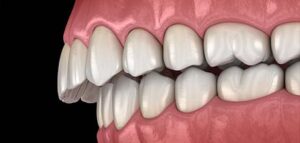
Open Bite
The space (gap) between the upper and lower anterior teeth is called an open bite.
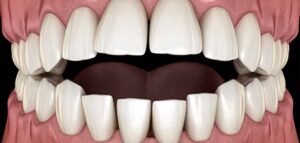
Crowding
A common orthodontic problem is crowding of the teeth, which occurs due to lack of space for the arrangement of the teeth in the dental arches at a young age, but also at an older age.
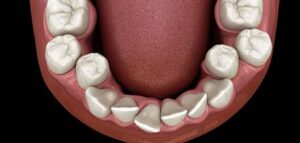
Crossbite malocclusion
Crossbite is a malocclusion in which the teeth of the lower jaw partially overlap those of the upper jaw. This can be the case with a single tooth or with a group of teeth and is differentiated into anterior and posterior crossbite.
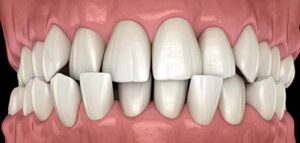
Crossbite malocclusion
Crossbite is a malocclusion in which the teeth of the lower jaw partially overlap those of the upper jaw. This can be the case with a single tooth or with a group of teeth and is differentiated into anterior and posterior crossbite.
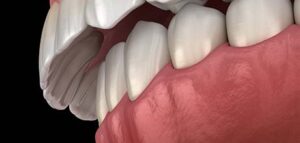
Deep Bite (or Overbite)
If the lower anterior teeth are largely covered by the upper anterior teeth, this is called a deep bite malocclusion, which in several cases leads to damage to the incisal surface of the lower teeth and causing injury to the palate.
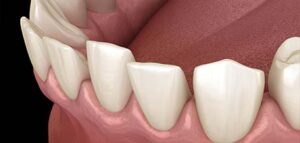
What are the most common orthodontic anomalies?
Oral hygiene instructions
During orthodontic treatment, patients must keep their orthodontic appliances clean and maintain good oral hygiene.
This requires a little more effort than someone who is not undergoing orthodontic treatment, but it is necessary in order to avoid cavities and gingivitis (inflammation of the gums). The patient should therefore follow our instructions regarding the oral hygiene protocol that will be given to them.
The oral hygiene protocols used are personalized and based on the needs of the patient. Every patient can and should maintain an excellent level of oral hygiene under our guidance during and after orthodontic treatment to have a beautiful and healthy smile for years to come.
Brushing teeth is usually required 3 times a day (definitely in the evening before bedtime – patients can then drink water only if they wish).
The toothbrush must be replaced when the bristles lose their original shape, which happens more quickly when orthodontic appliances are placed in the mouth. Brushing should take 2-3 minutes from all sides (inside, outside and above) to get sufficiently clean teeth and gums. Interdental cleaning of teeth is also important to maintain good oral hygiene. After the bonding of the orthodontic appliances, detailed instructions are bonded, the patient receives detailed instructions on proper tooth brushing, and the orthodontist monitors the patient throughout the orthodontic treatment.
Dietary Guidelines
During orthodontic treatment, the patient should avoid hard and sticky foods (e.g., popcorn, Greek honey, sesame bars, chewing gum, candies, nuts, cereal bars, etc.) when wearing fixed orthodontic mechanisms (braces), as they cause damage (e.g., braces coming off) that can complicate treatment and also affect dental health.
It is also desirable that all foods be cut into small pieces and that patients avoid biting on anything with their front teeth.
The good cooperation of a patient leads to better results and even in a shorter time!
Guidelines for orthodontic treatment with removable appliances
- Removable braces should be worn by the patient as often as possible. The minimum number of hours per day is 12 hours, and it should be removed especially when the patient wants to brush his teeth, exercise, swim at the beach, or eat a meal or snack. The patient can sleep, talk and drink water with this appliance. Sugary drinks (e.g. juices, milk with cocoa, etc.) should be avoided when the patient is wearing the appliance so that the removable appliance does not serve as a “trap” for caries-pathogenic microbes.
- It is important that when the removable appliance is removed, it is stored in the designated storage container so that it is not accidentally thrown, broken or damaged.
- The maxillary or mandibular expansion appliance must be cleaned daily with a soft toothbrush, and in any case before it is worn in the patient’s mouth.
- In the first few days, speech may be affected and there may be increased salivation. This is temporary and gradually decreases within the first week. The same applies to possible mild discomfort that may occur in some patients during the first days and will also gradually subside within the first week.
Emergencies
Food has been trapped between my teeth
This is not an emergency, but may be uncomfortable or embarrassing for the patient wearing braces. It can be easily managed by brushing teeth after each meal and using interdental brushes.
A metal attachment came out and bothers me on my lips/gums
If the metal attachment is prolonged and hurts you on the lips or cheeks/lips, you can reattach it with the edge of a cotton roll or apply the orthodontic wax to eliminate the irritation.
After the insertion of orthodontic mechanisms I have pain when chewing
It is normal to have a small irritation for three to four days after the brackets are placed or the aligners are placed on your teeth. This discomfort is more intense during meals, but it is normal and temporary. Light painkillers (e.g. paracetamol) and eating soft foods (pasta, soups, mashed potatoes) often help and reduce possible pain when chewing during the first few days.
There is no risk if you swallow the orthodontic wax, because it is harmless
In most cases, the discomfort subsides after a few days, when the oral mucosa “hardens” and adapts to the presence of the orthodontic mechanisms.
If a permanent wound is present, you can use one of the following remedies: Piralvex, Unisept, Aloclair or Hy + Al gel to effectively relieve and speed healing of minor injuries.
Something bothers me about the wire
If the wire has come loose from its position, try to reattach it with eyebrow tweezers. If it burns, put a small amount of orthodontic wax on it until you get to your appointment.
I swallowed a piece of my orthodontic mechanisms.
It happens especially rarely. Keep calm. It is very likely to pass through the stomach and then be removed from the body. However, if you notice difficulty breathing, you should call us as soon as possible.
There is a problem with my fixed retainer. I have lost/removed/broken them
You need to contact us as soon as possible to glue or replace it. Don’t delay, because your teeth can be moved
I noticed that the metal wire and small rubber bands around my braces came out of their place
If a rubber band comes out of place, you should stop using the intermaxillary elastics your orthodontist gave you, and he will replace them at your next appointment.
I notice blood on my gums when I brush my teeth
Gums bleed when brushing or flossing when there is inflammation/gingivitis in the area. Bleeding gums usually indicate that there is plaque in that area and it should be brushed better. In any case, your dentist will advise you depending on your clinical case.
I have wounds in my lips and cheeks
It is quite possible that minimal irritation may be caused during the first few days due to direct contact of the orthodontic mechanisms (e.g. braces, bands) with the lips and cheeks. The solution is to use a small amount of orthodontic wax, which alleviates the discomfort by protecting the area between the brackets and the lips/cheeks.
My bracket has been debonded, what should I do?
If we have given you intermaxillary “rubber bands”, you must stop using them immediately until you see us for re-bonding of the orthodontic mechanism.
A piece of my bracket or removable brace is broken
Take them out of your mouth and call us to repair them. If your removable braces are broken, don’t forget to bring them to the clinic.
I lost my retainer/aligner
Contact us directly to replace it as soon as possible so that the treatment result cannot be relapsed.
Visit us
Find the perfect treatment for your smile!

Specialist in Orthodontics Tagkli at Vari
VARIS’ CLINIC
6 Evelpidon Ave. & Ag. Apostolon 1, Vari 16672
210 89 92020
vari@orthodontikos-tagkli.gr
PIRAEUS’ CLINIC
33 Iroon Polytechniou Ave., Piraeus, 18532
210 41 79702
piraeus@orthodontikos-tagkli.gr
INFORMATION
© 2022 Orthodontics Tagkli | Cookies Policy | Privacy Policy